Piano chords and progressions are fundamental to music creation.
Resources like downloadable PDF cheat sheets simplify learning,
offering quick references for chords, scales, and common sequences.
These charts, often displaying chords in all keys,
aid beginners and experienced musicians alike in composing and improvising.
What are Piano Chords?
Piano chords are the building blocks of harmony, formed by playing three or more notes simultaneously. These notes are derived from a musical scale, typically major or minor. Understanding chord construction is crucial for navigating piano chord and progression PDF resources effectively.
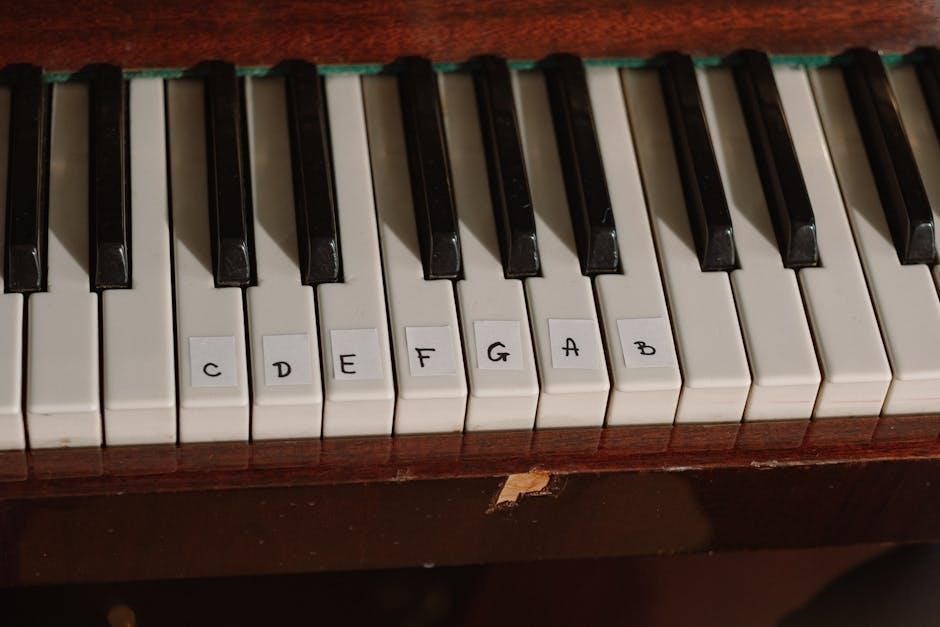
A basic major chord consists of the root, major third, and perfect fifth intervals. Minor chords replace the major third with a minor third. PDF cheat sheets visually represent these intervals, making chord identification easier. They often showcase chords in various inversions – different voicings of the same chord – enhancing musical texture.
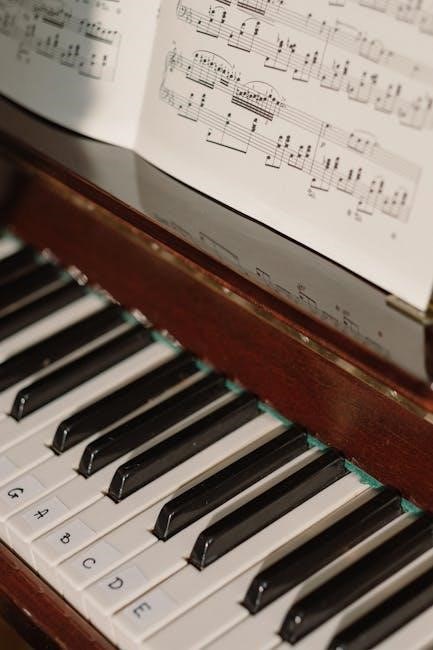
Beyond major and minor, PDF guides frequently include 7th chords, adding a fourth note to create richer harmonies. These resources are invaluable for beginners seeking a structured approach to learning chords and for producers needing quick references during composition, as highlighted in discussions on platforms like Reddit’s r/WeAreTheMusicMakers.
Understanding Chord Progressions
Chord progressions are sequences of chords played in a specific order, forming the harmonic foundation of a song. Piano chord and progression PDF resources often illustrate common progressions like I-IV-V-I, a cornerstone of many musical styles. These charts, sometimes resembling “Google Maps” for music as noted in product descriptions, allow musicians to visualize relationships between chords.
Understanding how chords function within a key is vital. PDFs frequently utilize Roman numeral analysis (I, IV, V, etc.) to represent chords relative to the key, making transposition easier. Resources like those found on websites mentioned in online discussions, demonstrate progressions in both major and minor keys.
More complex PDFs may include jazz-influenced progressions like ii-V-I, or emotionally resonant sequences like vi-IV-I-V. Mastering these progressions, aided by visual charts, empowers musicians to create compelling and memorable music.
Why Use a PDF Cheat Sheet?
Piano chord and progression PDF cheat sheets offer unparalleled convenience for musicians of all levels. As highlighted in online forums, they serve as excellent references, especially for beginners navigating the complexities of music theory. These PDFs consolidate essential information – chords, scales, and common progressions – into a single, easily accessible document.
Unlike flipping through books or searching online, a PDF provides instant access. Many are designed for high-resolution viewing and printing, allowing for zooming and detailed study. Resources like those from “Whipped Cream Sounds” offer visually rich charts, while others, like those from Roedy Black Music, present information on a single screen for quick reference.
Ultimately, a well-designed PDF accelerates learning, boosts creativity, and simplifies the process of composing and playing piano. They are invaluable tools for both practice and performance.
Basic Piano Chords
Basic piano chords – major, minor, and 7th – form the building blocks of countless songs. PDF resources simplify learning these essential chords and their voicings.
Major Chords: Construction and Examples
Major chords are typically bright and happy sounding, forming the foundation of many popular songs. They are constructed using the root, major third, and perfect fifth intervals of a scale. For example, a C major chord consists of C, E, and G.
PDF cheat sheets often visually represent these chords, showing finger placements on the piano keyboard. These resources are invaluable for beginners learning to identify and play major chords in all twelve keys. Understanding the construction allows musicians to build chords from scratch, rather than relying solely on memorization.
Common major chords include C Major, G Major, D Major, A Major, and F Major. Many piano chord and progression PDFs will showcase these chords alongside their corresponding chord symbols (e.g., C, G, D). Learning these foundational chords is the first step towards understanding more complex harmonies and chord progressions. The ultimate goal is to be able to quickly and accurately play these chords in any key, facilitating improvisation and songwriting.
Minor Chords: Construction and Examples
Minor chords generally evoke feelings of sadness or melancholy, contrasting with the brighter sound of major chords. They are built using the root, minor third, and perfect fifth intervals. For instance, A minor consists of A, C, and E. Recognizing the difference between major and minor thirds is crucial for chord identification.
Piano chord and progression PDFs frequently illustrate minor chords with clear diagrams, aiding in finger placement and visual learning. These resources often present chords in all keys, allowing musicians to quickly reference and play them. Understanding the construction of minor chords empowers musicians to create their own variations and progressions.
Common minor chords include A minor, E minor, D minor, and C minor. Many PDF resources will display these alongside their chord symbols (e.g., Am, Em, Dm, Cm). Mastering minor chords expands harmonic possibilities, enabling the creation of more emotionally resonant and diverse musical pieces. Consistent practice with these chords, guided by a cheat sheet, is key to fluency.
7th Chords: Adding Complexity
7th chords introduce a fourth note to the basic triad (root, third, fifth), creating a richer, more sophisticated harmonic texture. The most common type is the dominant 7th chord, often used to create tension and resolution in progressions. For example, a Cmaj7 chord consists of C, E, G, and B. These chords add color and depth to piano playing.
Piano chord and progression PDFs often dedicate sections to 7th chords, illustrating their construction and voicings. These visual aids are invaluable for beginners learning to navigate the added complexity. Resources may categorize 7th chords (major 7th, minor 7th, dominant 7th) for clarity.
Understanding 7th chords unlocks a wider range of harmonic possibilities, particularly in genres like jazz and blues. PDF cheat sheets provide quick references for various 7th chord voicings across different keys, accelerating the learning process. Mastering these chords elevates piano playing beyond basic triads, enabling more nuanced and expressive musical arrangements.
Common Chord Progressions
Chord progressions are sequences of chords, forming the harmonic foundation of songs. PDF resources often showcase popular progressions like I-IV-V-I,
I-V-vi-IV, and ii-V-I, aiding composition.
I-IV-V-I Progression: The Foundation
The I-IV-V-I progression is arguably the most fundamental in Western music, appearing in countless songs across genres. A PDF cheat sheet displaying this progression in various keys is invaluable for any pianist. It’s built upon the tonic (I), subdominant (IV), dominant (V), and back to the tonic (I) chord, creating a sense of resolution and completeness.
For example, in the key of C major, this translates to C-F-G-C. PDF charts often visually represent these chords, making it easy to identify finger positions. Understanding this progression allows musicians to quickly build harmonic structures and experiment with variations. Many resources, including those found as downloadable PDFs, demonstrate how to apply this progression to different musical styles, from pop and rock to blues and country.
The simplicity and effectiveness of I-IV-V-I make it a cornerstone for songwriting and improvisation; A well-designed PDF will also illustrate how to use inversions and variations to add interest to this classic progression.
I-V-vi-IV Progression: Popular and Versatile
The I-V-vi-IV progression is a remarkably popular choice among songwriters, known for its emotional depth and versatility. A comprehensive PDF chord chart will showcase this progression in all keys, enabling pianists to quickly grasp its application. In C major, this translates to C-G-Am-F, offering a pleasing blend of major and minor tonalities.
PDF resources often highlight how this progression creates a sense of longing and resolution, making it ideal for ballads and pop songs. The minor vi chord adds a touch of melancholy, while the IV chord provides a smooth transition back towards the tonic. Many PDF cheat sheets include variations and embellishments, such as adding 7th chords or using inversions.
Learning this progression from a PDF allows for easy experimentation and adaptation to different musical contexts. It’s a foundational element for understanding modern harmony and songwriting techniques, frequently appearing in contemporary music.
ii-V-I Progression: Jazz Influence
The ii-V-I progression carries a strong jazz influence, acting as a cornerstone of harmonic movement in the genre, and is frequently found in piano chords and progressions PDF resources. In C major, this becomes Dm-G-C, creating a sophisticated and resolving sound. PDF charts often illustrate this progression with various voicings and inversions, essential for jazz piano playing.
These PDF guides demonstrate how the ii-V-I creates a strong pull towards the tonic, making it a powerful tool for creating tension and release. The minor ii chord adds color, while the dominant V chord builds anticipation. Many PDFs will also show how to apply this progression to different keys and chord qualities.
Understanding this progression through a PDF cheat sheet unlocks a deeper understanding of jazz harmony and improvisation. It’s a vital building block for exploring more complex chord changes and soloing techniques.
vi-IV-I-V Progression: Emotional and Melodic
The vi-IV-I-V progression is renowned for its emotive quality, frequently appearing in popular music and detailed within piano chords and progressions PDF guides. In C major, this translates to Am-F-C-G, offering a melancholic yet hopeful feel. PDF resources often highlight its versatility, showcasing its use in ballads and pop songs.
These PDF charts demonstrate how the minor vi chord initiates a sense of longing, while the IV and I chords provide moments of resolution. The final V chord creates a satisfying cadence, preparing for repetition. Many PDFs will include variations and extensions of this progression.
Learning this progression via a PDF cheat sheet enhances songwriting capabilities and melodic development. It’s a foundational sequence for crafting emotionally resonant pieces, offering a rich harmonic palette for exploration.

Finding Chords on a Chart
Chord charts, often found in piano chords and progressions PDFs, utilize root notes and diagrams.
Understanding these visuals unlocks quick chord location and application across various keys.
Using Root Notes to Locate Chords
Root notes are the foundation for finding chords on any chart, especially within a piano chords and progressions PDF. These charts frequently organize chords by their root, allowing musicians to quickly identify a chord based on its starting note. For example, to find a C major chord, locate ‘C’ on the chart and then find the corresponding chord diagram.
Many PDF resources present chords in a grid format, with root notes listed across the top or down the side. This “map-like” approach, as described in several online resources, enables zooming and easy navigation. Understanding that a chord’s name (e.g., G major) directly corresponds to its root note (G) is crucial.
Furthermore, recognizing that chords repeat in different octaves simplifies the process. Once you locate a chord’s shape based on its root, you can easily play it higher or lower on the keyboard. This method is particularly helpful when working with charts that display multiple octaves or when transposing to different keys.
Understanding Chord Diagrams
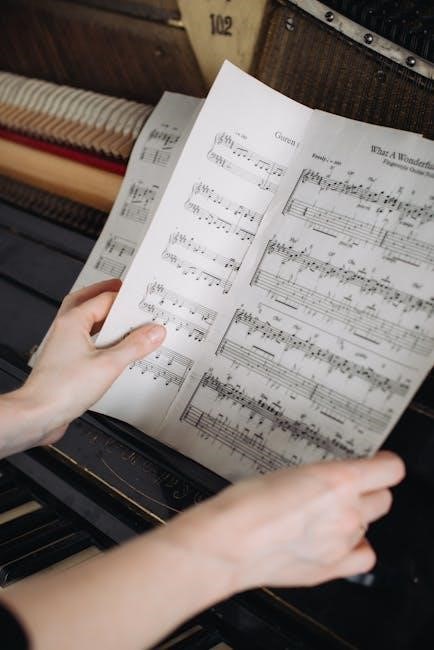
Chord diagrams within a piano chords and progressions PDF visually represent finger placement on the keyboard. These diagrams typically depict the piano keys, with dots or numbers indicating where to place your fingers to form a specific chord. Black keys are usually shaded differently for clarity.
Understanding the symbols is key: numbers often represent fingers (1=thumb, 5=pinky), while ‘x’ or ‘0’ might indicate muted strings or open strings (though less common on piano). Many PDF resources, like those found on websites offering printable charts, utilize a clear and consistent diagramming style.
Beginners should focus on learning to interpret these diagrams accurately. Practice matching the diagram to the keyboard, ensuring correct finger placement. Some charts also include chord names and inversions, providing a more comprehensive understanding. Mastering chord diagrams unlocks the ability to play a vast repertoire of songs and progressions quickly and efficiently.
Applying Charts to Different Keys
A valuable piano chords and progressions PDF often presents charts for multiple keys, or provides a method for transposing. Understanding how to apply these charts across different keys is crucial for musical flexibility. Many resources, like the “single screen” charts mentioned, allow zooming to easily view chords in various registers.
The principle relies on recognizing patterns. Once you understand a chord progression in one key (e.g., C major), you can apply the same relative pattern to other keys. For example, the I-IV-V progression remains I-IV-V regardless of the key – it’s just the specific chords that change.
PDF charts often include key signatures or indicate the root note for each chord. Learning to identify the root note and apply the appropriate fingerings from the chart will enable you to play the same progressions in any key, expanding your musical possibilities and improvisational skills.

Piano Chord and Progression PDFs
Piano chord and progression PDFs offer convenient, printable resources.
Options range from free downloads to paid, comprehensive guides,
providing charts and theoretical explanations for all skill levels.
Free Printable PDF Resources
Numerous websites offer free printable piano chord and progression PDFs, catering to various learning styles and musical goals. These resources are excellent starting points for beginners, providing fundamental chord charts and common progressions like I-IV-V-I and I-V-vi-IV. Reddit communities, such as r/WeAreTheMusicMakers and r/edmproduction, frequently share links to useful cheat sheets, including those with over 120 common chords neatly organized for easy reference.

Many of these free PDFs focus on major and minor keys, displaying chords in a visually accessible format. Some even incorporate Nashville Numbers, simplifying chord identification across different keys. These resources often allow zooming, mimicking a Google Maps interface for detailed viewing. While free options are abundant, evaluating their accuracy and completeness is crucial. Look for PDFs that clearly illustrate chord diagrams and provide sufficient examples to aid understanding. Websites like Roedy Black Music also provide high-resolution, printable chord progression charts.
Paid PDF Resources: What to Expect
Investing in paid piano chord and progression PDFs generally unlocks more comprehensive and specialized content. Unlike free resources, paid options often delve into advanced concepts like chord inversions, passing chords, and complex harmonic structures. Expect detailed explanations of music theory principles alongside extensive chord libraries covering various genres – jazz, blues, pop, and more.
These PDFs frequently boast higher production quality, with professionally designed layouts and clear, easy-to-read diagrams. Some include audio examples demonstrating chord voicings and progressions, enhancing the learning experience. Paid resources may also offer key-specific charts, allowing quick access to chords in any key signature. Furthermore, they often come with supplementary materials like practice exercises and song examples. When purchasing, consider the author’s credentials and read reviews to ensure the PDF delivers value and aligns with your musical aspirations. Expect a more in-depth and structured learning path compared to free alternatives.
Evaluating the Quality of a PDF

When selecting a piano chords and progressions PDF, careful evaluation is crucial. Begin by assessing the clarity and accuracy of the chord diagrams – are they easy to understand and free of errors? A high-resolution PDF is essential, allowing for zooming without pixelation, akin to a “Google Map” experience for chords, as some resources advertise.
Consider the scope of the content. Does it cover a sufficient range of chords and progressions for your needs? Look for resources that include both major and minor keys, and ideally, 7th chords and beyond. Check for logical organization and clear explanations of music theory concepts. Beware of PDFs with excessive advertising or poor formatting. User reviews can provide valuable insights into the resource’s effectiveness. A quality PDF should empower you to create memorable chord progressions, not overwhelm you with confusing information.
Advanced Chord Progressions
Exploring beyond basics, PDFs can unlock minor key progressions, inversions for smoother transitions, and passing chords.
These techniques elevate compositions, adding depth and harmonic interest.
Minor Key Progressions
Delving into minor keys unlocks a world of emotive possibilities, and PDF resources are invaluable guides. Unlike major keys, minor progressions often utilize chords built from the harmonic and melodic minor scales, creating distinct flavors. Common minor progressions include i-VI-III-VII (e.g., Am-F-C-G in A minor) and i-iv-V-i (Am-Dm-E-Am).
These charts frequently display chord variations within each key, including diminished and augmented chords, expanding harmonic palettes. Understanding relative major and minor keys is crucial; a PDF can visually demonstrate this relationship. Many resources showcase progressions used in popular songs, offering practical application.
Furthermore, PDFs often illustrate how to incorporate seventh chords into minor progressions for added complexity and color. Learning to analyze existing songs and identify their minor key progressions, aided by a cheat sheet, is a powerful skill for any pianist or composer. The availability of these resources accelerates learning and fosters creativity.
Using Inversions for Smooth Transitions
Chord inversions are essential for creating fluid and sophisticated piano playing, and PDF guides often dedicate sections to their application. Instead of always playing a chord in root position, inversions alter the bass note, resulting in smoother voice leading between chords. A PDF chart will visually demonstrate these variations – first, second, and third inversions – for each chord.
For example, transitioning from C major to F major is smoother using a C major first inversion (E-G-C) as an intermediary. These resources frequently highlight common inversion patterns within popular progressions. Understanding how inversions affect the melodic line within a progression is key.
Many PDFs include exercises to practice transitioning between chords using inversions, building muscle memory and ear training. Mastering inversions elevates piano playing beyond basic chord changes, adding a professional polish and harmonic richness. They are a cornerstone of advanced piano technique.
Adding Passing Chords
Passing chords introduce harmonic interest and movement within a piano chord progression, and comprehensive PDF resources often detail their use. These chords, typically non-diatonic, act as brief transitions between more structurally important chords, creating a sense of momentum. A PDF cheat sheet might illustrate common passing chord substitutions, like adding a diminished chord between two diatonic chords.
For instance, in a C-G-Am-F progression, a diminished chord could smoothly connect C and G. Understanding voice leading is crucial when incorporating passing chords; the goal is a seamless melodic connection. PDF guides frequently showcase examples in various keys and styles.
Effective use of passing chords requires ear training and a grasp of music theory. Many PDFs offer exercises to practice identifying and implementing these harmonic devices, enhancing your compositional skills and improvisational abilities. They add color and sophistication to otherwise standard progressions.

Resources and Tools
Online chord generators and apps simplify learning piano chords and progressions. Numerous websites offer PDF charts, aiding practice and composition.
Online Chord Generators
Online chord generators are invaluable tools for musicians exploring piano chords and progressions, especially when paired with PDF resources. These websites allow users to instantly visualize chords in various keys and inversions, aiding in understanding harmonic relationships. Many generators also demonstrate chord voicings, offering different ways to play the same chord for varied textures.
Several platforms go beyond basic chord displays, providing functionality to build chord progressions. Users can input a sequence of chords and hear how they sound together, facilitating experimentation and composition. Some generators even suggest related chords or common progressions based on the selected key and initial chords.
When utilizing these tools alongside piano chord and progression PDF cheat sheets, learning becomes more efficient. The generator provides immediate auditory feedback, while the PDF offers a comprehensive visual reference for chord structures and fingerings. This combination empowers musicians to quickly grasp new concepts and apply them to their playing or songwriting.
Apps for Learning Chords and Progressions
Piano chord and progression learning is significantly enhanced by dedicated mobile applications, complementing the use of PDF resources. These apps often feature interactive chord diagrams, allowing users to visualize finger placements and hear the corresponding sounds. Many provide exercises to practice chord transitions and build muscle memory, solidifying understanding beyond simply referencing a PDF.
Several apps specialize in chord progressions, offering pre-built sequences in various keys and styles. Users can experiment with different progressions, analyze their harmonic structure, and even record their own improvisations. Some apps incorporate ear training exercises, helping musicians identify chords and progressions by ear.
The synergy between apps and piano chord and progression PDF cheat sheets is powerful. Apps provide dynamic, interactive learning, while PDFs offer a static, comprehensive reference. This dual approach caters to different learning styles and ensures a well-rounded understanding of music theory and practical application.
Websites with Chord Charts and PDFs
Numerous websites offer free and premium piano chord charts and PDFs, serving as valuable resources for musicians of all levels. Many sites provide downloadable PDF cheat sheets covering basic to advanced chords, including major, minor, 7th, and extended chords. These PDFs often categorize chords by key, making it easy to find specific voicings.
Beyond static PDFs, interactive websites allow users to explore chords visually, often with audio samples. Some sites feature chord progression generators, enabling musicians to experiment with different sequences and analyze their harmonic qualities. Others offer comprehensive music theory lessons alongside chord charts.
Websites like Roedy Black Music specialize in high-resolution chord progression charts, offering a “Google Maps” style zoom function for detailed exploration. Whipped Cream Sounds provides downloadable piano chord PDFs with extensive graphics. Utilizing these online resources alongside dedicated practice enhances musical understanding and skill.