What Size Differential is in the Challenger Manual: A Comprehensive Guide (Updated 04/15/2026)
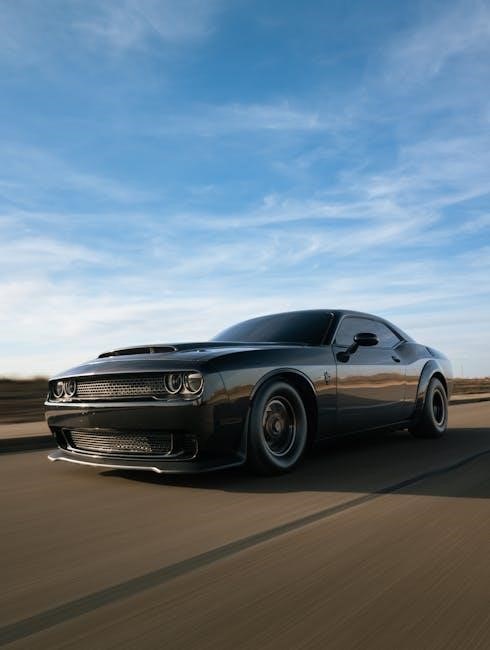
The 2009 Dodge Challenger SRT8 showcased a blend of classic muscle car aesthetics and contemporary power, offering a thrilling driving experience for enthusiasts.
The differential is a crucial, yet often overlooked, component within your Dodge Challenger’s drivetrain. Its primary function is to allow the wheels on each axle to rotate at different speeds – a necessity when cornering, as the outside wheel travels a greater distance than the inside one. Without a differential, handling would be severely compromised, and tire wear would be dramatically increased.
For manual transmission Challengers, understanding the differential’s size and type is particularly important for performance optimization and potential upgrades. Different Challenger trims and model years utilize varying differential setups, impacting everything from acceleration and top speed to overall driving dynamics. The 2009 SRT8, for example, demonstrated a powerful combination of retro styling and modern performance, highlighting the importance of a robust differential.
This guide will delve into the specifics of Challenger differentials, helping you identify what size and type your vehicle possesses, and explore the benefits of potential upgrades.
Why Differential Size Matters for Manual Challengers
For manual transmission Dodge Challengers, the differential size directly correlates to the vehicle’s ability to handle increased power and torque. A larger, more robust differential housing – like the 9.75” found in some models – can withstand the stresses generated by higher horsepower engines and aggressive driving styles, preventing potential failures.
The 2009 Challenger SRT8, with its potent engine, benefitted from a stronger differential setup. Smaller differentials, such as the 8.75”, may be adequate for lower-powered trims, but can become a weak link when paired with modifications like superchargers or performance tunes. This is especially true for manual Challengers where the driver has more direct control over power delivery.
Choosing the correct differential size is crucial for maximizing performance and ensuring long-term reliability. Upgrading to a larger or stronger differential can significantly improve traction, reduce wheel hop, and ultimately enhance the overall driving experience.

Identifying Challenger Differential Types
Dodge Challenger differentials vary significantly, with the Dana 30 and Dana 44 being prominent examples, each suited for different performance levels and trims.
Dana 30 Differential (Early Models ー Primarily R/T)
The Dana 30 differential frequently appears in earlier Dodge Challenger models, particularly those designated as R/T trims. This differential is known for its relatively lightweight construction and suitability for moderate power levels. While capable, it’s generally considered the less robust option compared to the Dana 44.
Typically found in Challengers from the 2008-2014 range, the Dana 30 utilizes a 7.25-inch ring gear. This size dictates its strength and torque handling capacity. Owners frequently upgrade components within the Dana 30, such as gears and carriers, to enhance durability for increased horsepower or more aggressive driving styles. However, there are inherent limitations to how much power the Dana 30 can reliably handle before requiring a complete replacement.
It’s crucial to understand that the Dana 30 is not designed for the extreme performance demands of higher-horsepower Challengers like the Hellcat or SRT8 models. Identifying a Dana 30 is often possible through visual inspection of the differential housing and, if present, the differential tag containing specific build information.
Dana 44 Differential (SRT8, Hellcat, and some later R/T models)
The Dana 44 differential represents a significant upgrade in strength and durability, commonly found in performance-oriented Dodge Challenger variants such as the SRT8 and Hellcat. Some later-model R/T Challengers also received the Dana 44, reflecting a need for increased robustness.
Distinguished by its larger 8.75-inch or 9.75-inch ring gear (discussed further in the housing size section), the Dana 44 is engineered to withstand considerably higher torque and horsepower levels. This makes it ideal for Challengers experiencing substantial power modifications or frequent track use. The increased strength translates to improved reliability and reduced risk of component failure under stress.
Identifying a Dana 44 often involves checking the differential housing size and verifying the presence of specific casting numbers. Upgrading to a Dana 44 is a popular modification for owners of earlier Challengers seeking to enhance their vehicle’s performance capabilities and overall drivetrain strength, providing a more confident driving experience.
8.75″ vs. 9.75″ Differential Housing Sizes
The differential housing size is a crucial indicator of the Challenger’s rear-end strength and capability. Two primary sizes are encountered: the 8.75-inch and the larger, more robust 9.75-inch. The number refers to the ring gear diameter the housing can accommodate.
Generally, the 8.75-inch housing is found in earlier R/T models and some base Challengers, suitable for moderate power levels. However, the 9.75-inch housing, prevalent in SRT8, Hellcat, and later R/T trims, offers significantly increased strength; This larger size allows for stronger ring and pinion gears, and thicker axle shafts.
Visually identifying the housing size requires careful measurement. A 9.75-inch housing provides a substantial performance advantage for high-horsepower applications and aggressive driving styles. Understanding this distinction is vital when considering differential upgrades or assessing a Challenger’s potential for modification, ensuring optimal drivetrain reliability.

Specific Differential Sizes by Challenger Year & Trim
Determining the exact differential size necessitates knowing the specific Challenger year and trim level, as manufacturers altered components throughout production runs.
2008-2014 Challenger Differential Specifications
Early model Challengers (2008-2014) presented a variety of differential setups depending on the engine and trim. The base V6 models typically utilized the Dana 30 differential, known for its lighter duty construction and suitability for lower horsepower applications. However, the R/T models, particularly those equipped with the 5.7L HEMI V8, often featured either the Dana 30 or transitioned to the more robust Dana 44 towards the later years of this generation.
Identifying the specific differential within this range requires careful consideration. The Dana 30 generally has a smaller ring gear size, while the Dana 44 boasts a larger, stronger design. Housing size also plays a role; the 8.75″ housing was common, but the Dana 44 often came with a 9.75″ housing for increased durability. Understanding these nuances is crucial for maintenance, repairs, or potential upgrades. Checking the vehicle’s original build sheet or differential tag (if present) provides the most accurate information.
2015-2023 Challenger Differential Specifications
The 2015-2023 Challenger generation saw a more defined differentiation in differential specifications based on performance levels. The standard V6 models continued to employ a variation of the Dana 30, though often with internal upgrades for improved strength. R/T models generally received the Dana 44, providing a significant boost in durability to handle the 5.7L HEMI’s power.
However, the true performance variants – SRT 392 and Hellcat – exclusively utilized the heavy-duty Dana 44 with a larger 9.75″ housing and stronger internals. This was essential to withstand the immense torque produced by the supercharged engines. Identifying the differential often involves checking the housing size or locating the factory differential tag. Furthermore, understanding the specific ratio installed impacts overall gearing and performance characteristics, making accurate identification vital for informed maintenance and modifications.
Differential Ratios and Their Impact on Performance
Differential ratios significantly influence a Challenger’s performance characteristics. Lower numerical ratios (e.g., 3.07:1) prioritize fuel economy and relaxed highway cruising, reducing engine RPM at speed. Conversely, higher ratios (e.g., 3.92:1 or 4.10:1) enhance acceleration and responsiveness, particularly from a standstill, but at the cost of increased fuel consumption and engine noise.
The SRT 392 and Hellcat models often featured lower ratios initially, balancing usability with immense power. However, many owners opt for higher ratios to unlock the full potential of their engines for drag racing or spirited driving. Selecting the appropriate ratio depends heavily on intended use and tire size. Changing the differential ratio alters the mechanical advantage, impacting both acceleration and top speed, requiring careful consideration for optimal results.

How to Determine Your Challenger’s Differential Size
Identifying your Challenger’s differential involves decoding the VIN, a visual inspection of the housing, and checking for a potentially present differential tag.
Decoding Your Vehicle Identification Number (VIN)
Your Challenger’s Vehicle Identification Number (VIN) is a unique 17-character code containing crucial information about your vehicle’s specifications, including the original differential setup. While not always directly stating the differential size, the VIN can reveal the trim level and engine option, which are strong indicators of the installed differential.
Several online VIN decoders are available, often free of charge, that can translate the alphanumeric code into a readable report. These reports typically detail factory-installed options, such as the engine type (e.g., 5.7L HEMI, 6.1L HEMI, 6.2L Supercharged HEMI) and trim level (e.g., SE, R/T, SRT8, Hellcat). Knowing these details narrows down the possible differential options significantly.
For example, an SRT8 model is highly likely to have a Dana 44 differential, while earlier R/T models often came equipped with a Dana 30. Remember that the VIN reflects the original factory configuration; modifications made by previous owners won’t be reflected in the VIN report. Always cross-reference the VIN findings with a visual inspection for confirmation.
Visual Inspection of the Differential Housing
A direct visual inspection of the differential housing is a reliable method for determining its size. This requires safely lifting the vehicle and accessing the differential, typically located beneath the rear of the car. The two primary housing sizes found in Challengers are 8.75 inches and 9.75 inches – measured across the ring gear.
To measure, locate the ring gear cover plate. While you don’t need to remove it, you can often estimate the size by visually comparing the housing to known dimensions. Alternatively, if the cover plate is removed (during maintenance, for example), a precise measurement across the ring gear can be taken with calipers or a ruler.
The 9.75-inch housing is noticeably larger and more robust than the 8.75-inch version, typically found in higher-performance models. Be cautious when working under a lifted vehicle and always use appropriate safety measures, such as jack stands.
Checking the Differential Tag (If Present)
Many Challenger differentials are equipped with a metal tag riveted to the housing, providing valuable information about the unit’s specifications. This tag, if still attached and legible, is often the easiest way to identify the differential size and gear ratio.
Locate the tag on the differential housing – it’s usually found on the passenger side. The tag will contain a series of numbers and letters. Look for a code that directly indicates the differential size, such as “8.75” or “9.75”. Additionally, the tag will display the gear ratio (e.g., 3.07, 3.55, 3.92).
However, be aware that these tags can become damaged, lost, or obscured over time. If the tag is missing or unreadable, other methods, like VIN decoding or visual inspection, will be necessary to determine the differential specifications.
Upgrading Your Challenger’s Differential
Enhancing the differential can significantly improve performance and durability, especially for Challengers undergoing modifications or experiencing increased power output from engine upgrades.
Benefits of a Differential Upgrade
Upgrading your Challenger’s differential offers a multitude of performance enhancements, particularly crucial when dealing with increased horsepower or aggressive driving styles. A stronger differential housing, like moving from an 8.75″ to a 9.75″, provides increased durability and resistance to bending or breaking under stress. This is vital for vehicles experiencing significant power increases from modifications.
Improved traction is another key benefit. Limited-slip differentials (LSDs) or locking differentials distribute power more effectively to both rear wheels, minimizing wheelspin and maximizing acceleration. This translates to quicker off-the-line launches and enhanced cornering capabilities. Furthermore, a differential upgrade can improve overall vehicle stability, especially during high-speed maneuvers or on uneven surfaces.
For those frequently engaging in track days or drag racing, a robust differential is essential for withstanding the extreme forces involved. Upgrading also allows for the selection of different gear ratios, tailoring the vehicle’s performance characteristics to specific driving needs – optimizing for either acceleration or top-end speed. Ultimately, a differential upgrade is a worthwhile investment for maximizing your Challenger’s potential.
Popular Aftermarket Differential Options
Several reputable manufacturers offer robust aftermarket differential solutions for the Dodge Challenger, catering to a wide range of performance goals and budgets. Yukon Gear & Axle is a prominent name, known for their complete differential kits including housings, gears, and limited-slip units. These kits often feature stronger alloys and improved heat treatment for enhanced durability.
Motive Gear provides another excellent selection of differential components, including gear sets and carriers, allowing for customized builds. For those seeking a complete, ready-to-install solution, Strange Engineering offers high-performance differentials designed for drag racing and aggressive street use. These typically include heavy-duty components and superior lubrication systems.
Finally, Eaton offers popular limited-slip differentials known for their smooth operation and reliable performance. When selecting an aftermarket differential, consider your vehicle’s power level, intended use, and budget. Professional installation is highly recommended to ensure proper setup and longevity of the upgraded component.
Resources for Further Information
Dedicated Challenger forums, such as ChallengerTalk.com and DodgeForum.com, provide invaluable platforms for owners to share knowledge, experiences, and technical insights regarding differential specifications and upgrades. These communities often feature detailed threads discussing specific model years, trims, and common issues related to differentials.
Online parts retailers like Summit Racing and Jegs High Performance offer extensive catalogs with detailed product descriptions and compatibility information for various Challenger differentials. Their websites also frequently include technical articles and guides to assist with selection and installation.
The official Dodge/Mopar website provides access to vehicle specifications and owner’s manuals, which may contain limited information about original differential setups. Furthermore, professional automotive technicians specializing in Mopar vehicles can offer expert advice and diagnostic services. Utilizing these resources will empower Challenger owners to make informed decisions regarding their vehicle’s drivetrain.